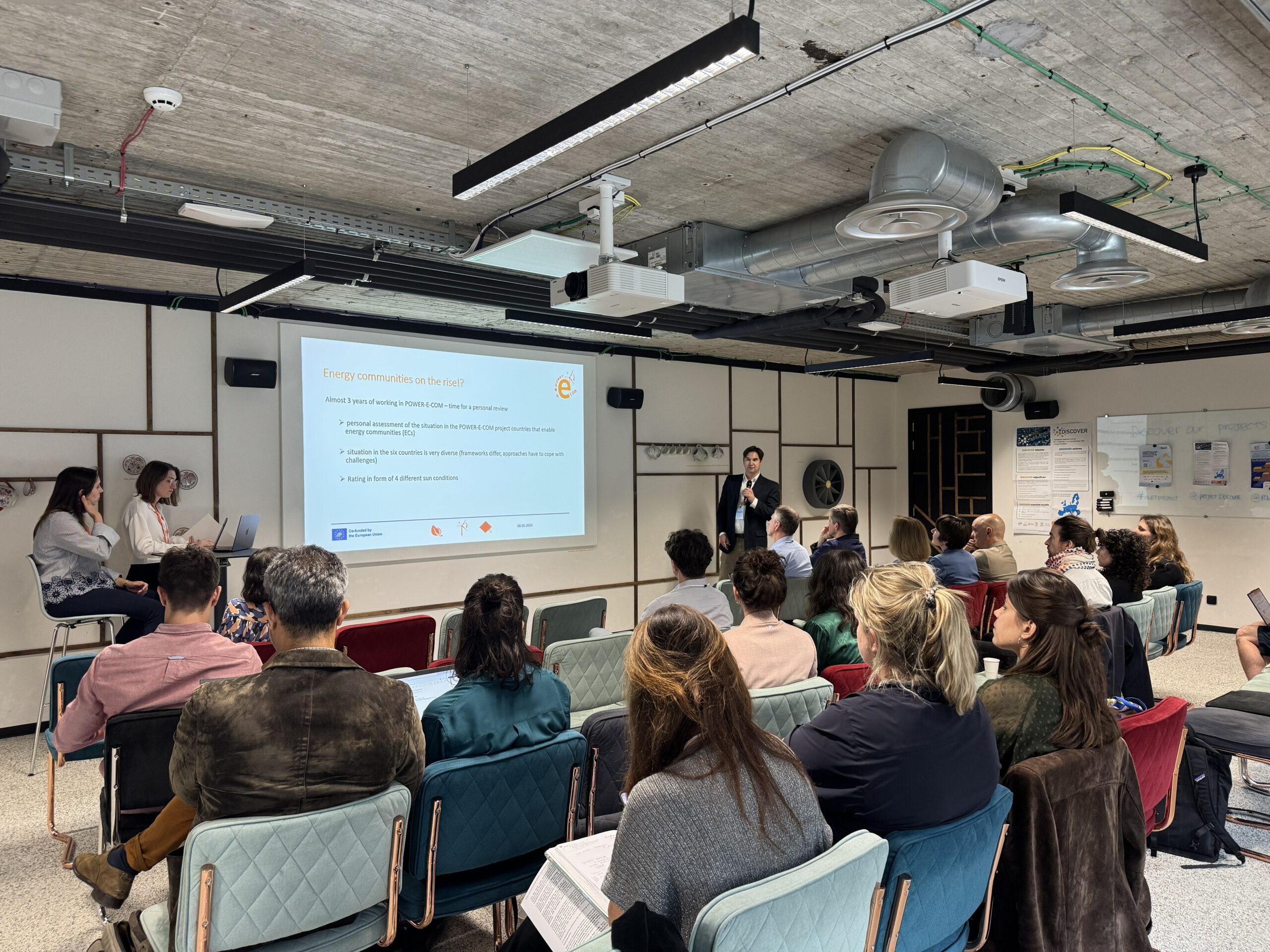
On 8 June 2026, the EU LIFE-funded projects POWER-E-COM joined forces with sister projects DISCOVER and ISLET for a joint final conference in Brussels – bringing together practitioners, policymakers, and energy community advocates from across Europe to share results, reflect on three years of project work, and discuss the road ahead for community energy.
The event, hosted at Comet Meetings Louise and streamed online, attracted participants from all six POWER-E-COM countries and beyond. You can watch the full recording on YouTube:
▶️ Watch the conference recording
Setting the scene: Why energy communities matter more than ever
The conference opened with a keynote by Vinicius Valente from CINEA, who has accompanied all three project consortia since the very beginning. He underlined that energy communities are increasingly seen as key actors in achieving Europe’s 2030 and 2050 climate targets – not least because they address multiple challenges at once: lowering energy costs, creating local jobs, building social cohesion, and reducing dependence on volatile global energy markets.
Crucially, Valente noted a shift in the barrier landscape: while regulatory and financial hurdles remain the biggest obstacles, lack of awareness and citizen interest – once the dominant barriers – have significantly decreased. The technology, he stressed, is no longer the problem.
POWER-E-COM: Six countries, six realities
Ingo Ball (WIP) presented a country-by-country assessment of where energy communities stand across the six POWER-E-COM partner countries – using a “sunshine rating” from rising sun to dark clouds.
The picture is mixed but cautiously optimistic. Austria stands out as a European frontrunner, with over 800 energy communities in the Upper Austria pilot region alone. Slovenia and Bulgaria are on a rising trajectory, with committed local partners driving progress. Spain received a boost from recent regulatory changes: a new Royal Decree in March 2026 extended the maximum distance for collective self-consumption from 2 to 5 km and increased the capacity threshold tenfold.
Germany and Ireland, however, remain challenged. In Germany, the legal basis for energy sharing only entered into force in June 2026 – but without smart meters (currently at just ~5% household penetration) and without reduced grid fees, real citizen participation remains out of reach for now. EWO’s work on local district heating networks in the Bavarian Oberland shows one way forward.
ISLET: Start with the community, not the technology
Alexis Chatzimpiros (Samsø Energiakademi) offered an important reminder: energy communities are, first and foremost, about people.
Drawing on ISLET’s experience across pilot islands in Greece, Italy and Croatia, he argued that projects fail when developers lead with technology and spatial planning rather than with the why – the local needs, values and stories that make change meaningful to communities. On the Italian island of Procida, for example, understanding the cultural significance of the local lemon was as important to community engagement as any technical feasibility study.
His core message: stakeholder engagement is not a work package. It is a continuous thread throughout the entire project.
DISCOVER: The challenges of success
Helmut Herglotz (Pixel Energy Solutions) brought an unexpected angle: what happens when a country succeeds too fast? With around 5,500 registered energy communities and a tenfold increase in newly installed PV between 2020 and 2023, Austria is now grappling with grid overload, regulatory catch-up, rising grid tariffs, and questions of social equity.
His five challenges for maturing energy community markets – grid capacity, regulatory adaptation, social inclusion, system cost distribution, and governance at scale – offer a roadmap for other countries approaching rapid growth.
POWER-E-COM: Business models in practice
Álvaro Moral (ESCAN) walked through real business model examples from Austria, Bulgaria and Spain – showing how the same underlying canvas approach produces very different solutions depending on local conditions.
From a 150-member renewable energy community in Austria, to a heating-focused community in Bulgaria’s coal-dependent regions, to a neighbourhood PV initiative in Getafe (Spain) that allocates 30% of production free of charge to vulnerable families – the examples illustrated a core lesson: there is no one-size-fits-all model, but there are replicable principles.
ISLET: Lessons from small Mediterranean islands
Élodie Bossio (FEDARENE) highlighted the particular challenges and opportunities of developing RECs on small Mediterranean islands – communities where energy systems are often isolated, tourism creates seasonal demand spikes, and institutional capacity is limited.
The ISLET experience showed that EU-funded projects provide something beyond technical support: the time and safety net to try, fail, learn and try again – as demonstrated by the team in Croatia, where legal barriers have so far prevented energy sharing despite the community being established and ready.
DISCOVER: Trust as the foundation
Damir Medved (Without Borders) closed the presentations with a direct call to action. In Croatia, where not a single kilowatt-hour has been exchanged despite years of effort, the root cause is a breakdown of institutional trust – between energy communities, DSOs and regulatory agencies.
His conclusion was clear: radical transparency within communities works. But if national-level institutions fail to respond, engage, or honour their legal obligations, citizen energy cannot thrive regardless of local will. He called on European institutions to strengthen monitoring of member state implementation and introduce mechanisms for rapid dispute resolution.
A full house – and a shared direction
The conference brought together practitioners from eleven European countries and closed with a lively Q&A and networking cocktail. The diversity of experiences reflects both the complexity of the challenge and the depth of knowledge now available across the POWER-E-COM, DISCOVER and ISLET consortia.
Leave a Reply